Machine learning is one of the most powerful technologies in 2026, used in everything from Netflix recommendations to self-driving cars and AI-powered healthcare. But what exactly is machine learning, and how is it used in real life?
In this complete guide, you’ll learn what machine learning is, how it works, real-life examples, types, applications, and future trends—all explained in simple terms.
What Is Machine Learning?
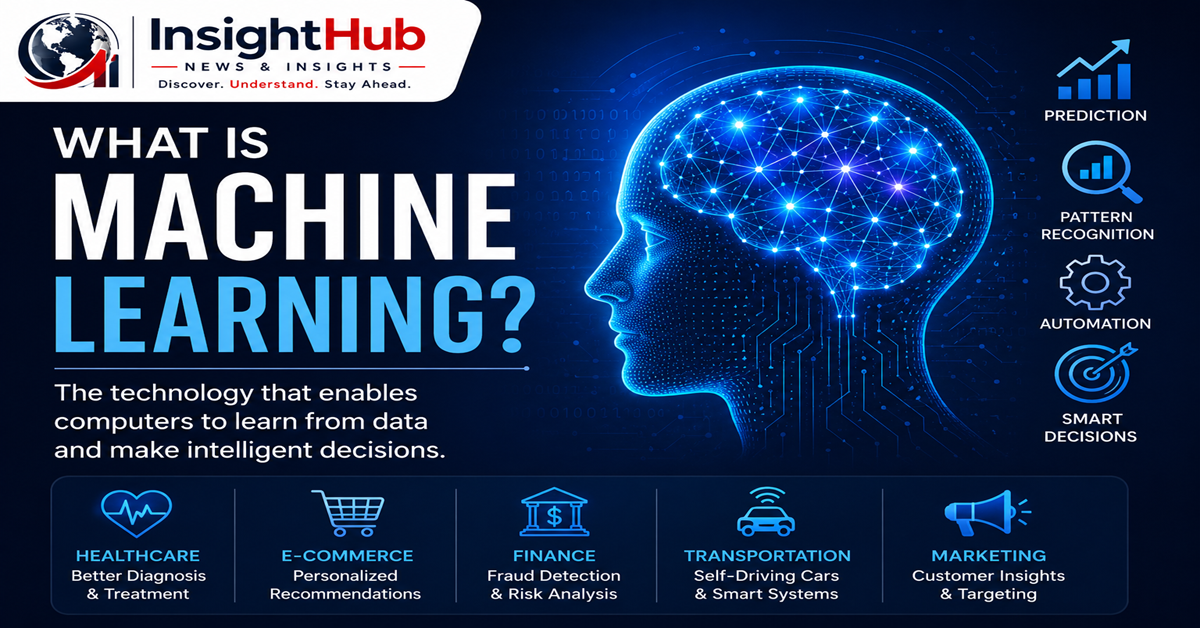
Machine Learning is a subset of Artificial Intelligence (AI) that enables computers to learn from data and improve their performance without being explicitly programmed. Instead of following predefined instructions, machine learning algorithms analyze patterns in data and make decisions or predictions based on those patterns.
In simple terms, machine learning allows systems to learn from experience just like humans do.
Key Definition:
Machine Learning is the science of training algorithms to automatically learn patterns from data and use those patterns to make predictions or decisions.
Real-Life Examples of Machine Learning
- Netflix recommendations
- Google search results
- Email spam filters
- Amazon product suggestions
- Self-driving cars
How Machine Learning Works
Machine learning works closely with cloud computing and artificial intelligence.
At its core, machine learning involves feeding data into an algorithm, allowing it to learn patterns, and then using those patterns to make predictions.
Step-by-Step Process:
1. Data Collection
The first step is gathering relevant data. This can include structured data (like spreadsheets) or unstructured data (like images, videos, or text).
2. Data Preparation
Data is cleaned and organized. This includes removing errors, handling missing values, and formatting the data.
3. Model Selection
A machine learning algorithm is selected based on the problem type (classification, regression, clustering, etc.).
4. Training the Model
The algorithm is trained using the dataset. It learns patterns by adjusting internal parameters.
5. Testing and Evaluation
The model is tested on new data to evaluate its accuracy and performance.
6. Deployment
Once the model performs well, it is deployed into real-world applications.
Types of Machine Learning
Machine learning can be broadly categorized into three main types:
1. Supervised Learning
Supervised learning is the most common type of machine learning. In this approach, the model is trained using labeled data, meaning the input data comes with the correct output.
Examples:
- Email spam detection
- House price prediction
- Medical diagnosis
Common Algorithms:
- Linear Regression
- Logistic Regression
- Decision Trees
- Support Vector Machines (SVM)
2. Unsupervised Learning
In unsupervised learning, the model works with unlabeled data. It tries to identify patterns or structures on its own.
Examples:
- Customer segmentation
- Market basket analysis
- Anomaly detection
Common Algorithms:
- K-Means Clustering
- Hierarchical Clustering
- Principal Component Analysis (PCA)
3. Reinforcement Learning
Reinforcement learning is inspired by behavioral psychology. The algorithm learns by interacting with an environment and receiving rewards or penalties.
Examples:
- Game-playing AI (like chess or Go)
- Robotics
- Autonomous vehicles
Key Machine Learning Concepts
Understanding these core concepts is essential for mastering machine learning:
1. Algorithm
A set of rules or instructions the model follows to learn from data.
2. Model
The output of the machine learning process that can make predictions.
3. Features
The input variables used to train the model.
4. Training Data
The dataset used to teach the model.
5. Overfitting and Underfitting
- Overfitting: Model learns too much detail and performs poorly on new data.
- Underfitting: Model fails to capture patterns in the data.
Popular Machine Learning Algorithms
Linear Regression
Used for predicting continuous values like prices or temperature.
Decision Trees
Used for classification and regression tasks.
Random Forest
An ensemble method that combines multiple decision trees.
Neural Networks
Inspired by the human brain, used in deep learning.
K-Nearest Neighbors (KNN)
Classifies data based on similarity.
Applications of Machine Learning in Real Life
Machine learning is used across various industries:
Healthcare
Machine learning is revolutionizing healthcare by enabling early diagnosis, personalized treatment, and predictive analytics.
Use Cases:
- Disease prediction
- Medical image analysis
- Drug discovery
Finance
Financial institutions use machine learning for fraud detection, risk assessment, and algorithmic trading.
Use Cases:
- Credit scoring
- Fraud detection
- Investment predictions
E-Commerce
Online platforms use machine learning to enhance customer experience and increase sales.
Use Cases:
- Product recommendations
- Customer behavior analysis
- Dynamic pricing
Transportation
Machine learning powers self-driving cars and smart traffic systems.
Use Cases:
- Autonomous vehicles
- Route optimization
- Traffic prediction
Marketing
Businesses use machine learning for targeted advertising and customer segmentation.
Use Cases:
- Email marketing automation
- Customer lifetime value prediction
- Ad targeting
Benefits of Machine Learning in 2026
1. Automation
Machine learning automates repetitive tasks, saving time and effort.
2. Improved Accuracy
ML models can analyze large datasets and provide highly accurate predictions.
3. Scalability
Machine learning systems can handle massive amounts of data efficiently.
4. Real-Time Processing
ML enables real-time decision-making in applications like fraud detection.
Challenges of Machine Learning
Despite its advantages, machine learning comes with challenges:
1. Data Quality
Poor-quality data leads to inaccurate results.
2. Complexity
Building and tuning models can be complex.
3. High Computational Cost
Training models requires powerful hardware.
4. Ethical Concerns
Issues like bias and data privacy are major concerns.
Machine Learning vs Artificial Intelligence vs Deep Learning
Understanding the difference is important:
- Artificial Intelligence: The broader concept of machines mimicking human intelligence.
- Machine Learning: A subset of AI that focuses on learning from data.
- Deep Learning: A subset of ML using neural networks with multiple layers.
Future of Machine Learning
The future of machine learning is incredibly promising. With advancements in computing power, big data, and algorithms, ML will continue to evolve rapidly.
Trends to Watch:
- Explainable AI (XAI)
- Edge Computing
- AutoML (Automated Machine Learning)
- AI in Healthcare
- Natural Language Processing (NLP)
Machine learning will play a critical role in shaping industries, improving efficiency, and solving complex global problems.
How to Get Started with Machine Learning
If you want to start your journey in machine learning:
1. Learn Programming
Python is the most popular language for ML.
2. Understand Mathematics
Focus on statistics, probability, and linear algebra.
3. Practice with Projects
Work on real-world datasets.
4. Use ML Tools
Popular libraries include:
- TensorFlow
- Scikit-learn
- PyTorch
Conclusion
Machine learning is transforming the world by enabling computers to learn from data and make intelligent decisions. From healthcare and finance to marketing and transportation, its applications are endless.
As technology continues to evolve, machine learning will become even more integrated into our daily lives, driving innovation and efficiency across industries. Understanding machine learning today is not just an advantage-it's a necessity for the future.
FAQs
What is machine learning in simple words?
Machine learning allows computers to learn from data and make decisions automatically.
Where is machine learning used?
It is used in healthcare, finance, e-commerce, and transportation.
What are examples of machine learning?
Examples include Netflix recommendations, spam filters, and self-driving cars.
Is machine learning safe to use?
Machine learning is generally safe, but it depends on how data is used. Privacy, bias, and security are important considerations when implementing ML systems.
Why is machine learning important for the future?
Machine learning is important because it drives innovation, automates industries, improves decision-making, and enables advanced technologies like self-driving cars and smart cities.
How do social media platforms use machine learning?
Social media platforms use machine learning to personalize feeds, recommend content, detect fake accounts, and show targeted advertisements based on user behavior.
Can beginners learn machine learning easily?
Yes, beginners can start learning machine learning using online courses, Python programming, and simple tools. Many platforms now offer beginner-friendly resources.