ChatGPT vs Google – The New Search Battle
For over two decades, Google has dominated the way we search for information online. Typing keywords, scanning blue links, and clicking websites has been the standard experience.
But in 2026, a major shift is happening:
👉 The rise of AI-powered search tools like ChatGPT is challenging Google’s dominance.
The debate of ChatGPT vs Google is no longer just about technology—it’s about the future of the internet.
Instead of browsing multiple websites, users now expect instant, accurate, and conversational answers. This shift is transforming SEO, content creation, and even job markets.
In this article, we explore how AI search is replacing traditional Google search and what the ChatGPT vs Google competition means for the future.
What Is AI Search?
AI search refers to search systems powered by artificial intelligence that understand natural language and provide direct answers instead of just links.
In the ChatGPT vs Google comparison:
- ChatGPT delivers conversational, detailed responses
- Google still relies heavily on indexed web pages (though evolving)
Example:
Instead of typing:
👉 “best smartphone 2026”
Users now ask:
👉 “Which smartphone is best for photography under $1000?”
AI gives a direct, human-like answer instantly.
AI search is transforming how users interact with information online by understanding context, intent, and human language. This technology is powered by advanced systems like machine learning algorithms, which enable AI to deliver accurate and intelligent responses.
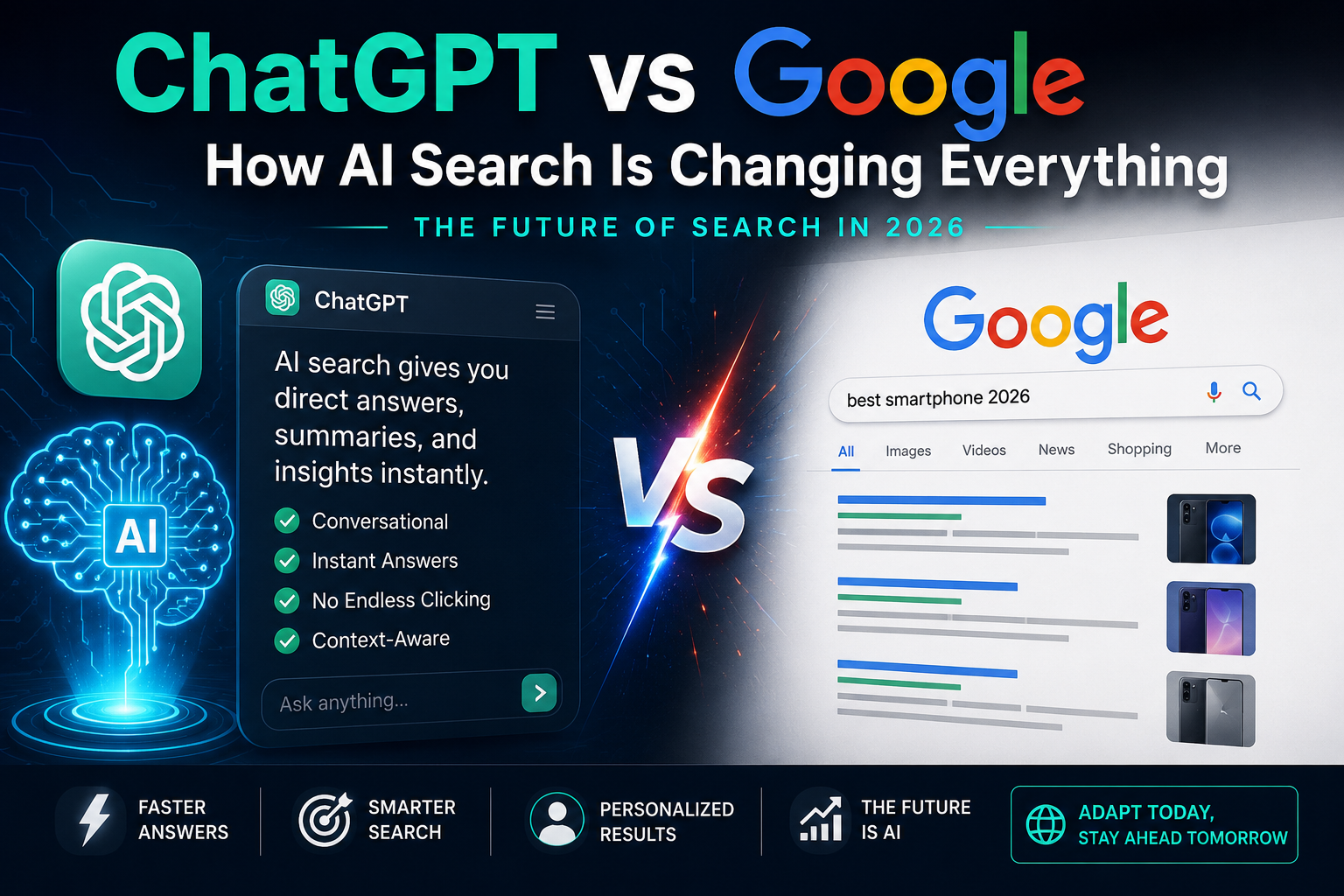
ChatGPT vs Google: Key Differences
🔍 Google Search:
- Keyword-based results
- List of websites
- Requires multiple clicks
- SEO-driven rankings
🤖 ChatGPT (AI Search):
- Conversational answers
- Direct responses
- No need to browse multiple sites
- Context-aware
👉 The biggest difference in ChatGPT vs Google is simple:
Google shows options, ChatGPT gives answers.
How AI Search Works
AI search systems like ChatGPT use advanced technologies:
1. Natural Language Processing (NLP)
Understands human queries in natural form.
2. Machine Learning
Improves results based on user interactions.
3. Large Language Models (LLMs)
Generate human-like responses.
4. Context Awareness
Remembers previous questions for better answers.
5. Data Aggregation
Combines information from multiple sources instantly.
Why Google Is Moving Toward AI
The ChatGPT vs Google competition has forced Google to evolve rapidly.
Google is introducing:
- AI-generated summaries
- Conversational search
- Smart recommendations
Why?
👉 Users want answers, not links.
Google’s survival depends on adapting to AI-driven expectations.
Impact on Websites and Bloggers
The rise of AI search and the ChatGPT vs Google shift is changing everything.
1. Decrease in Click-Based Traffic
Users get answers without visiting websites.
2. Content Quality Matters More
Only authoritative content gets featured in AI results.
3. E-E-A-T Becomes Critical
- Experience
- Expertise
- Authority
- Trust
4. Long-Form Content Wins
Detailed articles are more likely to be used by AI.
5. Brand Recognition Is Key
Trusted websites are prioritized.
How ChatGPT vs Google Is Changing SEO
SEO in 2026 is completely different.
Old SEO:
- Keyword stuffing
- Backlinks
- Ranking tricks
New SEO:
- Answer-focused content
- Topic authority
- User intent optimization
- Structured data
👉 In the ChatGPT vs Google era, SEO is about helping AI understand your content.
Best AI Search Tools in 2026
With the rise of ChatGPT vs Google, several AI tools are gaining popularity:
- Conversational AI platforms
- Smart assistants in devices
- Industry-specific AI search engines
These tools are redefining how users interact with information.
Impact on Jobs and Careers
The ChatGPT vs Google revolution is reshaping careers.
Jobs at Risk:
- Basic content writers
- Traditional SEO specialists
- Data entry roles
Jobs in Demand:
- AI content creators
- SEO strategists (AI-focused)
- Prompt engineers
- Digital marketers
👉 Those who adapt to AI will thrive.
AI is also transforming income opportunities, allowing individuals to earn through automation, freelancing, and digital platforms. Many of these methods are explained in our guide on how to make money online in 2026, especially in the era of AI-driven tools.
Pros and Cons of AI Search
Advantages:
✔ Instant answers
✔ Better user experience
✔ High accuracy
✔ Personalized results
Disadvantages:
❌ Less traffic for websites
❌ Risk of incorrect AI answers
❌ Reduced visibility for small creators
Future of Search: Who Will Win?
The ChatGPT vs Google battle will define the future of search.
What to Expect (2026–2030):
- Fully conversational search
- Voice-based queries dominate
- Personalized AI assistants
- Zero-click searches increase
👉 Instead of one winner, we may see integration:
Google + AI = Hybrid search experience
This transformation is part of a larger trend shaping the future of digital experiences, particularly in the evolution of AI search engines and how users interact with information online.
How to Adapt in the ChatGPT vs Google Era
To succeed, follow these strategies:
1. Create Valuable Content
Focus on solving real problems.
2. Write for Humans + AI
Clear, structured, informative content.
3. Use Schema Markup
Help search engines understand your content.
4. Build Authority
Consistency and trust are key.
5. Optimize for Questions
Answer real user queries.
FAQs
Q1: ChatGPT vs Google – which is better?
ChatGPT is better for direct answers, while Google is better for exploring multiple sources.
Q2: Will ChatGPT replace Google?
Not completely. It will transform how search works.
Q3: How does this affect SEO?
SEO will increasingly focus on content quality, user intent, and delivering real value to readers. As search engines evolve with AI, modern digital marketing strategies in 2026 are also adapting to these changes, emphasizing personalization, automation, and data-driven decisions.
Q4: Can websites still get traffic?
Yes, but only high-quality and authoritative sites.
Q5: What is the future of search?
AI-driven, conversational, and personalized.
Conclusion
The ChatGPT vs Google debate marks a turning point in digital history.
Search is no longer about finding links—it’s about getting answers instantly.
While this transformation may challenge traditional websites, it also creates new opportunities for those who adapt.
👉 The future belongs to creators who focus on quality, authority, and user value.
If you understand this shift, you won’t just survive—you’ll dominate the AI-driven future.