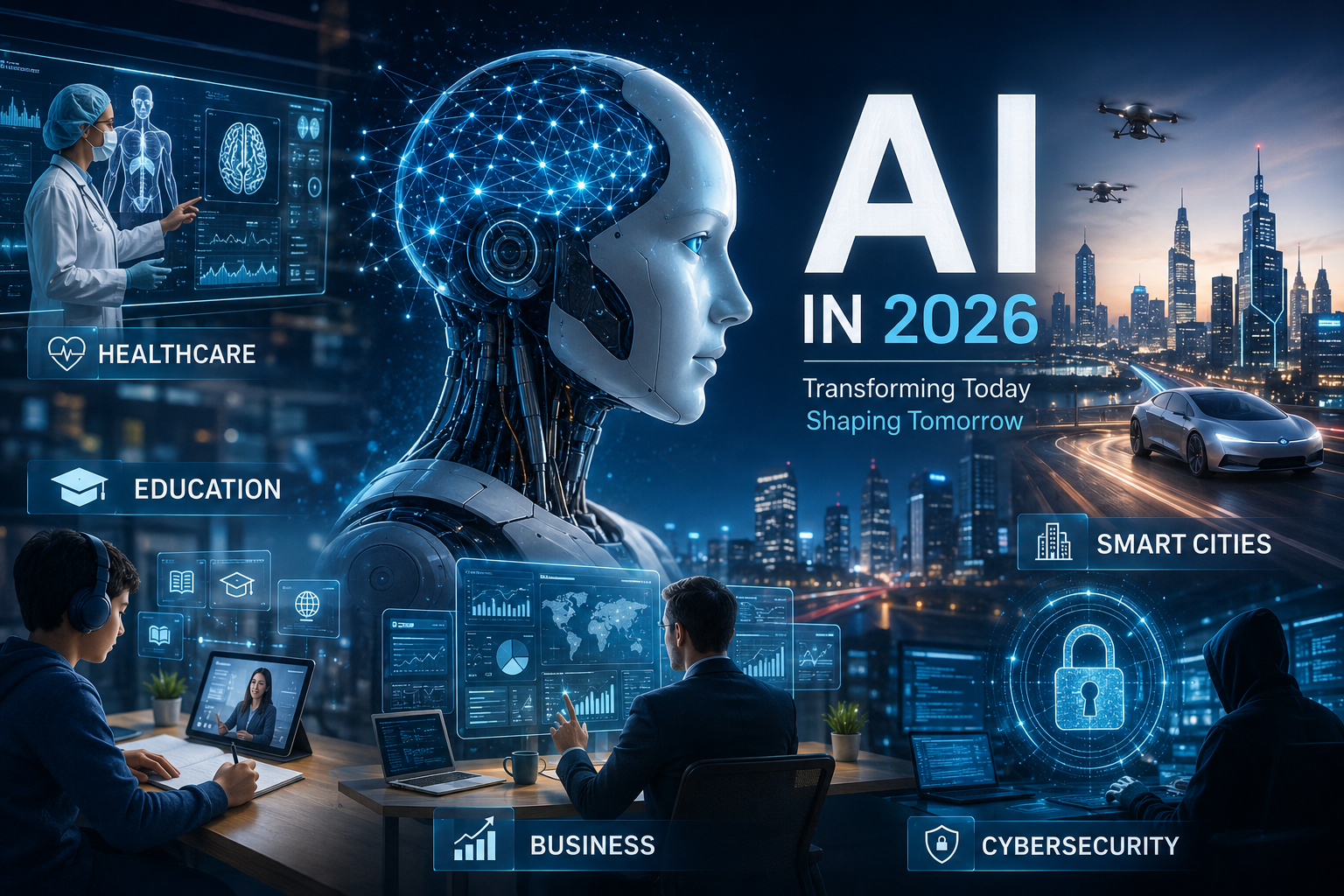
Artificial Intelligence (AI) has rapidly evolved from a futuristic concept into one of the most powerful technologies shaping the modern world. In 2026, AI is no longer limited to research labs or science fiction—it is deeply integrated into everyday life, powering everything from smart assistants and recommendation systems to advanced healthcare solutions and self-driving vehicles.
Businesses, governments, and organizations across the globe are investing heavily in AI to automate processes, analyze massive datasets, and improve decision-making. As a result, understanding what artificial intelligence is, how it works, and why it matters has become essential for anyone navigating the digital era.
AI is widely used in modern technologies such as cloud platforms and data-driven systems. To understand how AI works with large-scale data processing, you can explore cloud computing and data science.
In this guide, you will learn everything about AI, including its types, real-world applications, benefits, challenges, and future trends.
What is Artificial Intelligence?
Artificial Intelligence refers to computer systems designed to perform tasks that typically require human intelligence, such as learning, reasoning, problem-solving, and decision-making.
👉 In simple words:
AI enables machines to think, learn, and act intelligently using data.
A Brief History of Artificial Intelligence
The concept of intelligent machines dates back centuries, but modern AI research began in the 1950s.
1950s - The Beginning
British mathematician Alan Turing proposed the famous Turing Test, designed to determine whether a machine could demonstrate human-like intelligence.
In 1956, researchers officially coined the term "Artificial Intelligence" during the Dartmouth Summer Research Project.
1960s-1970s
Researchers focused on symbolic reasoning and expert systems capable of solving mathematical and logical problems.
1980s
Expert systems became popular in business applications, helping organizations automate specialized decision-making processes.
1990s
Machine learning gained popularity as computers became more powerful and larger datasets became available.
2000s
Internet growth produced enormous amounts of data, fueling AI development across many industries.
2010s
Deep learning revolutionized AI through neural networks capable of recognizing images, understanding speech, and translating languages with remarkable accuracy.
Today
Modern AI systems generate text, create images, write software, assist doctors, optimize logistics, and support scientific discoveries.
Types of Artificial Intelligence
AI can be classified into several categories.
Narrow AI
Also known as Weak AI, Narrow AI is designed to perform a specific task.
Examples include:
- Voice assistants
- Spam filters
- Recommendation systems
- Image recognition
- Navigation software
Nearly all AI applications currently in use belong to this category.
General AI
General AI refers to machines capable of understanding, learning, and performing any intellectual task that humans can perform.
Although researchers continue exploring this possibility, General AI has not yet been achieved.
Super AI
Super AI is a hypothetical stage where machines surpass human intelligence in every field.
This concept remains theoretical and raises significant philosophical and ethical questions.
How Artificial Intelligence Works
AI systems rely on several technologies working together.
Machine Learning
Machine Learning allows computers to learn patterns from data without explicit programming.
The more high-quality data the model receives, the better it becomes at making predictions.
Common machine learning methods include:
- Supervised Learning
- Unsupervised Learning
- Reinforcement Learning
Deep Learning
Deep Learning uses artificial neural networks inspired by the human brain.
It excels in:
- Image recognition
- Speech recognition
- Natural language processing
- Video analysis
Deep learning has dramatically improved AI performance in recent years.
Natural Language Processing (NLP)
Natural Language Processing enables computers to understand, interpret, and generate human language.
Applications include:
- Chatbots
- Language translation
- Voice assistants
- Email classification
- Sentiment analysis
- Document summarization
Computer Vision
Computer Vision enables machines to understand images and videos.
It is widely used in:
- Medical imaging
- Facial recognition
- Manufacturing quality inspection
- Autonomous vehicles
- Security systems
Robotics
AI-powered robots perform physical tasks requiring precision and adaptability.
Industries using robotics include:
- Manufacturing
- Healthcare
- Agriculture
- Warehousing
- Space exploration
Applications of Artificial Intelligence
AI has become an essential component across many sectors.
Healthcare
Healthcare has experienced remarkable improvements through AI.
Applications include:
- Disease detection
- Medical image analysis
- Drug discovery
- Personalized treatment
- Hospital management
- Remote patient monitoring
AI helps physicians make faster and more accurate decisions while reducing administrative workloads.
Finance
Banks and financial institutions use AI for:
- Fraud detection
- Credit scoring
- Investment analysis
- Risk management
- Customer service
- Automated trading
AI processes millions of transactions in real time, identifying suspicious activities more efficiently than traditional systems.
Education
AI supports personalized learning experiences.
Examples include:
- Intelligent tutoring systems
- Automated grading
- Learning analytics
- Adaptive learning platforms
- Student performance prediction
Teachers also benefit from AI-powered administrative tools that reduce paperwork.
Manufacturing
Factories use AI to improve productivity through:
- Predictive maintenance
- Quality inspection
- Inventory management
- Supply chain optimization
- Industrial robotics
These technologies reduce downtime and operational costs.
Retail and E-commerce
Retail companies use AI for:
- Product recommendations
- Customer behavior analysis
- Dynamic pricing
- Inventory forecasting
- Virtual shopping assistants
Personalized shopping experiences improve customer satisfaction and sales.
Transportation
Transportation systems increasingly rely on AI.
Applications include:
- Traffic management
- Autonomous driving
- Fleet optimization
- Route planning
- Predictive maintenance
These technologies improve safety and reduce transportation costs.
Agriculture
Modern farming uses AI for:
- Crop monitoring
- Disease detection
- Smart irrigation
- Soil analysis
- Harvest prediction
AI helps farmers maximize productivity while reducing environmental impact.
Entertainment
Streaming platforms use AI to recommend movies, television shows, music, and podcasts based on user preferences.
Game developers also use AI to create intelligent characters and personalized gaming experiences.
Benefits of Artificial Intelligence
AI offers numerous advantages across industries.
Increased Productivity
Automation allows employees to focus on higher-value work rather than repetitive tasks.
Better Decision Making
AI analyzes enormous datasets much faster than humans, identifying patterns that might otherwise remain hidden.
Cost Reduction
Organizations reduce operational expenses by automating routine processes.
Improved Accuracy
AI minimizes human error in many applications, particularly in manufacturing, finance, and healthcare.
24/7 Availability
Unlike humans, AI systems can operate continuously without fatigue.
Personalization
AI creates customized experiences based on individual preferences and behaviors.
Faster Innovation
Researchers use AI to accelerate discoveries in medicine, engineering, climate science, and many other fields.
Challenges and Limitations
Despite its advantages, AI also presents significant challenges.
Data Privacy
AI systems often require large volumes of personal data, raising concerns about privacy and data protection.
Bias
AI models can unintentionally reflect biases present in training data, leading to unfair outcomes.
Job Displacement
Automation may replace certain routine jobs while creating demand for new skills and professions.
Security Risks
Cybercriminals can exploit AI for sophisticated attacks, making cybersecurity increasingly important.
Lack of Transparency
Some AI models operate as "black boxes," making it difficult to explain how decisions are reached.
High Development Costs
Building advanced AI systems often requires significant investments in infrastructure, expertise, and computing power.
Ethical Considerations
Responsible AI development requires addressing important ethical questions.
Organizations should prioritize:
- Transparency
- Fairness
- Accountability
- Privacy
- Security
- Human oversight
Governments and technology companies continue developing frameworks to ensure AI benefits society while minimizing risks.
Artificial Intelligence in Business
Businesses increasingly integrate AI into everyday operations.
Common use cases include:
- Customer support automation
- Marketing optimization
- Sales forecasting
- Human resources
- Business intelligence
- Financial planning
- Supply chain management
Companies that adopt AI strategically often achieve improved efficiency, stronger customer relationships, and greater innovation.
The Future of Artificial Intelligence
The future of AI promises even more transformative developments.
Experts anticipate advancements in:
- Personalized healthcare
- Scientific research
- Climate modeling
- Smart cities
- Advanced robotics
- Autonomous transportation
- Space exploration
- Education
- Creative industries
Future AI systems are expected to become more capable, efficient, and accessible, enabling individuals and organizations to solve increasingly complex challenges.
At the same time, society must carefully address ethical considerations, regulatory frameworks, workforce transitions, and responsible innovation to ensure AI serves the broader public interest.
Preparing for an AI-Driven World
Individuals can prepare for the future by developing skills that complement AI rather than compete with it.
Important skills include:
- Critical thinking
- Creativity
- Communication
- Emotional intelligence
- Problem-solving
- Data literacy
- Digital skills
- Continuous learning
Organizations should invest in employee training, ethical AI governance, and responsible technology adoption to remain competitive.
AI is also integrated into smart devices and everyday tools. You can explore real-world examples in Top 10 Gadgets in 2026.
Conclusion
Artificial Intelligence is more than a technological trend-it represents a fundamental shift in how humans solve problems, create value, and interact with the digital world. From healthcare and education to finance, manufacturing, agriculture, and entertainment, AI is transforming nearly every aspect of modern life.
While challenges such as privacy, bias, security, and workforce adaptation require careful attention, the opportunities created by AI are immense. Organizations that embrace responsible AI innovation can improve efficiency, enhance customer experiences, and unlock new possibilities for growth.
As artificial intelligence continues to evolve, it will increasingly become an integral part of everyday life. Understanding its capabilities, limitations, and ethical implications will help individuals, businesses, and governments make informed decisions in an AI-powered future. By combining technological innovation with human creativity, collaboration, and responsible governance, society can harness the full potential of artificial intelligence for the benefit of future generations.